
“What we observe is not nature herself, but nature exposed to our method of questioning.”
— Werner Heisenberg
Okay, I get it. AI is the hot topic.
It was the hot topic yesterday, it is the hot topic today, and there is a decent chance your toaster and favorite shoe will have an AI strategy by the time you finish reading this.
And rightly so. Artificial intelligence is already changing how we work, how companies spend money, how governments think about infrastructure and, apparently, how often the word Nvidia can appear in a single earnings call. But there is not much value in being the 47th person today to tell you that AI is important.
By design, Amarna is meant to look beyond what is already obvious; beyond the stories already occupying every screen, every conference stage and every investor presentation. The interesting things are often not the ones demanding your attention today, but the ones quietly building underneath the surface until, suddenly, they are impossible to ignore.
And when you look across the technologies that could shape the next decade or two, quantum computing fits that description almost perfectly. It is important enough to attract billions in investment, strategically important enough for governments to treat it as a national priority, and strange enough that most people (me included) would struggle to explain exactly how it works without reaching for a metaphor about parallel universes.
Perfect, so I thought quantum was an appropriate place to begin.
Amarna’s first publication is about a technology that is not ready yet, may take years to fulfill its biggest promises, and could nevertheless become one of the most consequential technological shifts of our lifetime.
Before we start looking at companies, valuations and who might actually make money from all of this, there is one small problem – we need to understand what the hell quantum computing actually is.

So, what the hell is quantum computing and why does it want my money?
A quick disclaimer before we go any further:
I am not a quantum physicist and neither am I a quantum engineer. In fact, at the time of writing this, I am probably about as far from quantum computing as I am from Fiji – and, given the choice, I would quite happily be closer to Fiji.
But that is partly the point.
You should not need a PhD in theoretical physics to understand why a technology might matter, what problem it is trying to solve, or why investors are suddenly pouring serious money into it. So instead of pretending we already know all of this, let’s do something more useful and let’s get smarter together.
By the end of this article, the goal is not to turn either of us into a quantum researcher. It is simply to understand enough to answer a few basic questions without immediately developing a headache:
- What exactly is a quantum computer?
- Why are so many intelligent people spending so much money trying to build one?
- What could it actually be useful for?
And perhaps most importantly for us: who stands to benefit if this thing actually works?
To get there, unfortunately, we need to start with the smallest possible building block.

Let the qubit inside
A normal computer works with bits. A bit is simple: it is either a 0 or a 1 and is the most you will get out of your school computer class.
A quantum computer uses qubits instead. The important difference is that, before we measure them, qubits can exist in a combination of 0 and 1 at the same time – what physicists call superposition. That sounds more mystical than it needs to, so the useful part is this: quantum computers can manipulate a much richer set of possibilities than ordinary computers can represent in the same way.
Add more qubits, connect them through entanglement, and use quantum interference to push the calculation toward useful answers, and suddenly you have a machine that can approach certain problems very differently from a classical computer.
Not every problem and probably not even most problems, but for the right ones, potentially very important ones.
That is really all we need for now: a qubit is not just a smaller bit. It is the building block of a different way of computing.

So why should I care now?
Fair question. If quantum computing is still years, maybe decades, away from becoming something you actually notice in daily life, then why are we spending perfectly valuable work hours reading about it?
Because the race has already started and it is simply happening largely outside the media spotlight.
While most of the technology conversation is consumed by AI, governments, universities, defense agencies, Big Tech and specialized start-ups are already spending serious money on quantum infrastructure, talent, research and supply chains.
The strange part is that, for something that could eventually become one of the most important technological developments of this century, quantum still receives surprisingly little attention outside scientific and specialist circles. We are effectively watching enormous bets being placed in advance.
Cooling systems are being built, lasers are being perfected, new chips are being designed, governments are funding national programs, companies are choosing architectures. Entire ecosystems are forming around machines that, for most people, still sound closer to science fiction than infrastructure.
On top of it, none of this guarantees that quantum computing will transform the world. But if it does, the groundwork will have been laid long before this technology becomes visible to the average person.
That is why the better question is not:
“When will I personally use a quantum computer?”
It is:
“What is already being built today for a future that most of us are not paying attention to yet?”

Where is my money Lebowski?
This is Amarna, after all. At some point we have to stop admiring the physics and ask who is paying for all of this, and the answer, increasingly, is everyone with deep enough pockets.
IBM alone recently committed more than $10 billion over five years to quantum computing.[1] The US government is putting billions into quantum companies, foundries and research programs. The UK has committed £2.5 billion over a decade, while similar programs exist across Europe and Asia.[2]
Universities and national laboratories already have quantum computers installed, companies can access machines through the cloud and some organizations even operate dedicated systems on site. So saying that quantum is not commercial would not quite be true, but it is just not yet commercial in the way that really matters to the average person.
Today, much of the industry still revolves around research, experimentation, government programs, scientific partnerships and companies preparing for a future use case. Naturally, there are customers, revenue, machines being sold.
What we do not yet have at scale is something much more important:
A company buying quantum computing because the economics make it stupid not to.
There are really two stages to crossing it.
- Commercial access.
Can a company get its hands on useful quantum hardware without becoming a quantum laboratory itself?
That transition is already happening through cloud platforms and dedicated installations. IBM, for example, says more than 340 organizations across industry, academia, healthcare and government use its quantum systems today.
- Commercial necessity.
Can a pharmaceutical company discover a molecule materially faster?
Can a materials company design something it could not realistically simulate before?
Can a bank improve a calculation enough to justify the cost?
Can a logistics company solve a problem better than the best classical system already sitting in its data center?
When the answer becomes consistently yes, quantum stops being a research budget and thus becomes proper infrastructure.
And there is one more thing worth clearing up: we probably should not wait for the day somebody walks into a shop and buys a quantum computer. That may never happen.
These machines are enormous, delicate and surrounded by specialized cooling, control electronics and other equipment. The more likely future looks a lot like today’s supercomputing and cloud infrastructure: most users will never see the physical machine – they will simply pay to use it like you might use AI tokens today.
Which means the real commercial question is not:
“When can I buy a quantum computer?”, but “When will companies start paying for quantum because not using it puts them at a disadvantage?”
That is the inflection point and somewhere between today’s research machines and that future sits an entire investable ecosystem.

Why not just use AI?
Let me step on my own foot and talk about AI again, because apparently, we are not getting out of this conversation that easily.
If AI is already helping with molecules, materials, finance, optimization and just about everything else, why spend billions building another machine inside a giant refrigerator?
Why don’t I just lease my backyard and a well to a hyperscaler and let AI do the work?
Because AI and quantum are not really doing the same job: AI is extraordinarily good at finding patterns, making predictions and approximating answers using classical computers, while quantum computing may eventually handle certain problems that remain fundamentally difficult for classical machines, no matter how many GPUs we throw at them.
AI can make classical computing much smarter, but it does not make classical computing stop being classical. The future is probably not AI or quantum. It is much more likely to be AI, classical computing and quantum working together, each doing the part it is best suited for.
Sometimes the answer is a better algorithm, sometimes, we may need a different kind of machine.

What can we actually invest in?
At some point, a financial publication has to do financial things.
The quantum race is crowded. There are start-ups, university spin-outs, government-backed laboratories, defense programs and private companies burning through investor capital in pursuit of whichever version of the quantum computer they believe will eventually work. But for us, the market can initially be divided into two fairly simple camps.
Public and private.
On the public side, there is another important distinction.
We have the giants: IBM, Alphabet, Microsoft, Amazon and others. These companies are spending serious money on quantum, building their own systems and competing for talent, patents and government partnerships. On the other hand, buying Microsoft because you believe in quantum is a little like buying an airline because you like the peanuts.
Quantum may eventually become enormously important to the company, but today it remains a very small part of a much larger machine.
Then we have the companies where quantum is the machine.
Quantinuum, IonQ, Rigetti, D-Wave, Infleqtion, Xanadu, Quantum Computing Inc. – these are much closer to what we are looking for. Admittedly, not because they are necessarily better investments — some of them may ultimately disappear — but because their fortunes are far more directly tied to whether their particular approach to quantum technology actually succeeds.
And then there is the private world.
A substantial part of the quantum industry still sits here: companies financed by venture capital, strategic investors and governments, developing technologies that public-market investors simply cannot buy directly today.
There is also a slightly more personal reason I want to keep this part of the market on our radar. I am writing this from France, and one company I have been following for some time is Alice & Bob, a Parisian quantum company building its machines around something wonderfully named the cat qubit.
Alice & Bob was founded in 2020 and has since raised more than €180 million. In 2026, it presented its first complete quantum system, Helium, and France agreed to acquire an 18-cat-qubit machine for its national high-performance computing infrastructure (TGCC for the ones in the know).[3]
They are private, so for now there is no ticker for us to put money behind, but they are also partly responsible for why I started paying closer attention to this industry in the first place. And perhaps one day we will get the chance to sit down with the people building it and ask them some of these questions ourselves.
Until then, we watch. For this first publication, though, our attention is going to remain primarily on the companies we can buy.
There is no Nvidia of quantum. Yet.
Twenty years ago, Nvidia was not alone.
The graphics market had ATI, 3dfx and plenty of other companies fighting over what would eventually become one of the most valuable pieces of computing infrastructure on Earth. Some disappeared. ATI ended up inside AMD. Nvidia, meanwhile, went on to become the dominant force.
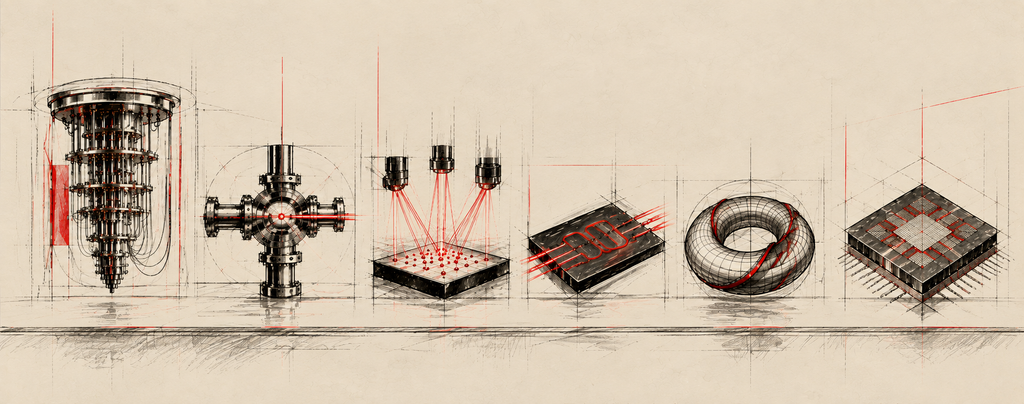
Quantum today has a little bit of that feeling, except the disagreement runs even deeper. The companies are not competing to build the best quantum computer, instead they cannot even agree on what a quantum computer should physically be made from.
Somewhere inside this mess, one technology may eventually prove to offer the best combination of speed, accuracy, scalability and cost; or perhaps several survive because each turns out to be better suited to different jobs.
For now, the bets look like this:
- Superconducting circuits — IBM, Google, Rigetti and IQM. Tiny electrical circuits are cooled to temperatures close to absolute zero and made to behave quantum mechanically. Amazon is also pursuing a superconducting variation using cat qubits, while our French friends at Alice & Bob are making a similar cat-qubit bet privately. The attraction is speed and semiconductor-like manufacturing, but the cost is cooling, wiring and scaling.
- Trapped ions — IonQ and Quantinuum. Instead of manufacturing a qubit, take an actual atom, remove an electron, hold the resulting ion in place and control it with lasers. These systems can be extremely accurate, but operations tend to be slower and scaling the optical and control systems is its own challenge.
- Neutral atoms — Infleqtion. Similar idea, but the atoms remain electrically neutral and are held in position using lasers. Large arrays are possible without the giant dilution refrigerators used by superconducting systems, although controlling thousands of atoms precisely is far from trivial.
- Photons — Xanadu and, through a somewhat different approach, Quantum Computing Inc. Here, light itself does the work. Xanadu is building a fault-tolerant architecture around photonic chips and optical networking, while QCi is pursuing room-temperature quantum optics and integrated photonics. No giant fridge sounds attractive; reliably generating and controlling enormous numbers of photons is the game.
- Topological qubits — Microsoft. Microsoft has spent years pursuing perhaps the strangest bet of the group: encoding information into exotic topological states that should, in principle, be naturally more resistant to errors. The potential prize is enormous precisely because error correction is one of quantum computing’s biggest problems.
- Silicon spin — Intel. Intel is betting that quantum could eventually borrow much more directly from the semiconductor industry we already know, encoding qubits using electron spins in silicon and trying to manufacture them with CMOS-style processes.
And then there is D-Wave, which deserves its own box entirely. Its machines use quantum annealing, a more specialized approach aimed principally at optimization and sampling rather than building the same sort of universal gate-based machine pursued by most of the companies above.
So when somebody asks which quantum stock is “the best,” there is a problem with the question. Buying IonQ instead of Rigetti is not quite like choosing Pepsi over Coca-Cola.
There is no Nvidia of quantum yet, simply because there is no general consensus on what the GPU is.

Let’s end the quantum charades.
Up to this point, we have had the luxury of being curious, but now we have to be useful.
It is easy to say quantum computing could become important, but is considerably harder to decide which company deserves your money while the technology is still being invented. This is where Amarna has to take a position.
We are not looking for the company with the biggest qubit number, the coolest laboratory or the most convincing presentation deck – instead let’s look for asymmetry.
A company needs four things to interest us:
- Technology. Is there a credible reason its approach could actually work at scale?
- Commercialization. Is somebody outside the company willing to pay for what it is building?
- Survival. Does it have enough capital, partnerships and institutional support to remain alive long enough for the technology to mature?
- Price.
Because a wonderful technology bought at an absurd valuation can still be a terrible investment. We need to find the companies where the technology is credible, the path toward revenue is becoming visible (and viable!), the balance sheet can survive the full journey – while the market has not already priced in perfection.
Our job is to figure out which ones deserve a closer look.
Fine. Here are our three.
So, it is time to make some choices, but a small disclaimer first – these are not forever picks.
This article is being published on 25 September 2026. Quantum is moving quickly, the companies are moving quickly, valuations are moving even faster, and this piece will eventually become part of a living Amarna dossier that we intend to revisit as the evidence changes. But research becomes fairly useless if you never actually make a call.
Feel free to tear them apart like your local Flock camera.

THE AMARNA PICK — IONQ
If we had to choose one listed pure-play today, IonQ is the one we would put at the center of the board.
Not because trapped ions have definitively won the architecture race. They haven’t.
But IonQ currently gives us the strongest combination of technical credibility, commercial traction and financial endurance.
Second-quarter revenue reached $80.1 million, up 287% year-on-year. Roughly 60% came from commercial customers, around half came internationally, and the company ended June with roughly $2 billion of cash and investments on a pro-forma basis after its SkyWater acquisition. Since then, IonQ has raised its 2026 revenue outlook to $450–460 million following the addition of SkyWater.
More importantly, IonQ is gradually becoming more than a company with an interesting qubit. Computing, networking, sensing, security and now semiconductor manufacturing are beginning to sit under the same roof.
The catch, however, is obvious – everybody else has noticed. At the 24 September close, IonQ was worth roughly $18 billion. This is no undiscovered penny stock waiting for somebody to notice the science. Expectations are already substantial.
So this is our highest-conviction company, not necessarily our highest-upside one.[4]
THE ASYMMETRIC BET — INFLEQTION
For that, we move to something smaller and stranger.
The bet here is neutral atoms. Instead of fabricating superconducting circuits or trapping charged ions, Infleqtion uses ordinary neutral atoms controlled with lasers – an architecture that could ultimately allow very large arrays while avoiding some of the extreme cryogenic infrastructure required elsewhere.
But what makes Infleqtion particularly interesting to us is that the company is not waiting for general-purpose quantum computing to arrive before trying to sell quantum technology. It operates across quantum sensing, timing and navigation, giving it potential commercial routes that may mature earlier than fault-tolerant computing.
Q2 revenue was $13.5 million, up 157% year-on-year, with 2026 guidance of approximately $45.1 million. It reported roughly $582 million in cash, securities and restricted cash at quarter-end, with no debt, although part of that balance reflected a temporary working-capital benefit.
At the 24 September close, the entire company was valued at roughly $3.2 billion.
That is still an enormous valuation relative to today’s revenue, but, as stated, this is the asymmetric slot.
If neutral atoms emerge as one of the scalable architectures and Infleqtion turns its sensing business into something economically meaningful along the way, today’s company could look very different. If neither happens, this one can hurt. And that is the point.[5]
THE ARMS DEALER — FORMFACTOR
And finally, perhaps the most cowboy choice of the three.
What if we are completely wrong about which qubit wins? Then maybe we should own somebody selling the shovels to the people trying to find out.
FormFactor builds semiconductor test equipment and specialized cryogenic systems used to characterize quantum devices at extremely low temperatures. In March it introduced a benchtop dilution refrigerator specifically aimed at quantum hardware validation. Quantum does not even need to become FormFactor’s entire business for the thesis to work.
The company already generated $258.2 million of Q2 revenue, $56.2 million of GAAP net income and $52.6 million of free cash flow, with its larger business benefiting from semiconductor testing, high-bandwidth memory and advanced packaging.[6]
So if superconducting quantum expands, FormFactor can sell into the cryogenic testing problem, but if quantum takes longer than expected, there is still an actual profitable semiconductor-equipment company underneath the thesis.
There is, as always, one rather annoying detail – the market has been paying attention here too. FormFactor was worth roughly $10.1 billion on 24 September after a very strong 2026 run.
Our arms dealer is safer operationally, but it is definitely not cheap.[7]
Note: In the process of writing this, FormFactor managed to evict Palantir from my watch list. No disrespect to Palantir, but it just turns out that selling the equipment to people attempting to bend the laws of physics is fairly effective at getting my imagination to work.
Into the Beyond
The thesis is written, the picks are on the table, and now the market gets to prove us right or wrong.
Quantum will not stand still from here as companies will burn cash, technologies will improve, valuations will move, and some of today’s contenders may not be around when we come back. That is precisely why this is not a conclusion, but a timestamp.
The fridge stays on. So do we.
Enjoyed the dossier?
Amarna stays free. If this piece gave you something worth thinking about, you can help fund the next one with a coffee.
Or just buy us a coffee.